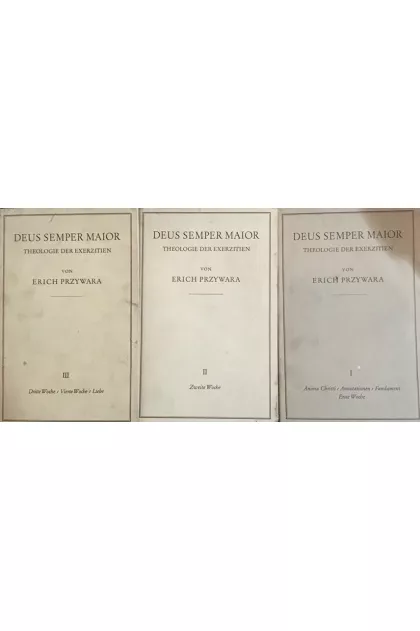
Theologie der exerzitien - Tom I - III , 1938 r. - Erich Przywara
Tom I - 1938 r. , 256 s.
Tom II - 1939 r. , 355 s.
Tom III - 1940 r. , 442 s.
Erich Przywara (12 October 1889, Katowice – 28 September 1972, Hagen near Murnau) was a Jesuit priest, philosopher, and theologian of German-Polish origin, who was one of the first Catholics to engage in dialogue with modern philosophers. He is best known for synthesizing the thought of prominent thinkers around the notion of the analogy of being, the tension between divine immanence and divine transcendence, a "unity-in-tension".While the concept of the analogy of being is not original to Przywara (having originated in the schools of the Catholic orders), with Przywara the concept undergoes a dramatic enrichment that is fed, on the one hand, by his love of "music as form" and by his early readings of Augustine, Dionysius the Areopagite, Thomas Aquinas, and John Henry Newman.
Przywara’s later work was both a refinement and radicalization of themes within his earlier theology. In Humanitas (1952), for instance, Przywara continued his analysis of modern theology and philosophy, in this case focusing on anthropology in particular. Just like his earlier Himmelreich (1922/23), Przywara also continued writing exegetical works. He planned to write commentaries on the Gospels, but in the end, only published a commentary on the Gospel of John (Christentum gemäß Johannes; 1954) while his writings on Matthew remain unpublished. Equally, Alter und Neuer Bund (1956), whose initial form was a series of talks given in Berlin, Vienna, and Munich during World War II, explores the relationship between the Old and New Testament. Przywara offers a theological diagnosis of the times through his Mariological, ecclesiological, and Christological readings of the Old Testament. In this work Przywara calls the cross of Christ the ‘energetic’ which powers the transition between the old and the new covenant.
The late Przywara, particularly in his Logos, Abendland, Reich, Commercium (1964), also developed a theology of the commercium, or "wondrous exchange." The idea of the commercium comes from the O admirabile commercium sung at the Vigil of Epiphany. The commercium stands as a summary of all the "exchanges" within the New Testament: that in Jesus Christ the free, righteous, and blessed God becomes a servant, sin, and suffers death so that an enslaved, sinful, and suffering humanity might be freed, made righteous, and inherit eternal life. Equally important, however, is the connubium, or the nuptial union between Christ and believers .