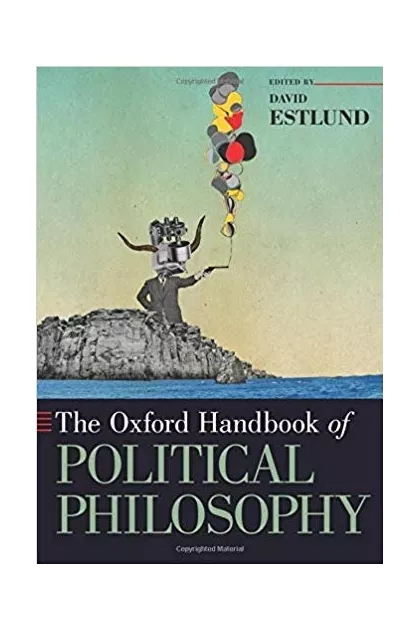
Political Philosophy - David Estlund
Political philosophy
From Wikipedia, the free encyclopedia
Jump to navigationJump to search
"Political Theory" and "political treatise" redirect here. For the academic journal, see Political Theory (journal). For the work by Baruch Spinoza, see Tractatus Politicus.
Plato (left) and Aristotle (right), from a detail of The School of Athens, a fresco by Raphael. Plato's Republic and Aristotle's Politics secured the two Greek philosophers as two of the most influential political philosophers.
Part of a series on
Politics
Primary topics[show]
Political systems[show]
Academic disciplines[show]
Public administration[show]
Policy[show]
Organs of government[show]
Related topics[show]
Subseries[show]
Politics Portal
v
t
e
Part of a series on
Philosophy
Plato
Kant
Nietzsche
Buddha
Confucius
Averroes
Philosophers
Aestheticians
Epistemologists
Ethicists
Logicians
Metaphysicians
Social and political philosophers
Traditions
African
Analytic
Aristotelian
Buddhist
Chinese
Christian
Augustinian
Thomist
Scotist
Occamist
Humanist
Continental
Eastern
Egyptian
Existential
Hellenistic
Neoplatonic
Indian
Hindu
Jain
Jewish
Judeo-Islamic
Pragmatism
Islamic
Avicennist
Averroist
Classical
Illuminationist
Sufi
Middle-Eastern
Iranian
Platonic
Western
Periods
Ancient
Medieval
Modern
Contemporary
Literature
Aesthetics
Epistemology
Ethics
Logic
Metaphysics
Political philosophy
Branches
Aesthetics
Epistemology
Ethics
Legal philosophy
Logic
Metaphysics
Political philosophy
Social philosophy
Lists
Index
Outline
Years
Problems
Publications
Theories
Glossary
Philosophers
Miscellaneous
Philosopher
Philomath
Philalethes
Wisdom
Women in philosophy
Philosophy portal
v
t
e
Political philosophy, also known as political theory, is the study of topics such as politics, liberty, justice, property, rights, law, and the enforcement of laws by authority: what they are, if they are needed, what makes a government legitimate, what rights and freedoms it should protect, what form it should take, what the law is, and what duties citizens owe to a legitimate government, if any, and when it may be legitimately overthrown, if ever.
Political theory also engages questions of a broader scope, tackling the political nature of phenomena and categories such as identity, culture, sexuality, race, wealth, human-nonhuman relations, ecology, religion, and more.
Political philosophy is a branch of philosophy,[1] but it has also been a major part of political science, within which a strong focus has historically been placed on both the history of political thought and contemporary political theory (from normative political theory to various critical approaches).
In the Oxford Handbook in Political Theory (2006), the field is described as: "[...] an interdisciplinary endeavor whose center of gravity lies at the humanities end of the happily still undisciplined discipline of political science ... For a long time, the challenge for the identity of political theory has been how to position itself productively in three sorts of location: in relation to the academic disciplines of political science, history, and philosophy; between the world of politics and the more abstract, ruminative register of theory; between canonical political theory and the newer resources (such as feminist and critical theory, discourse analysis, film and film theory, popular and political culture, mass media studies, neuroscience, environmental studies, behavioral science, and economics) on which political theorists increasingly draw."[2]