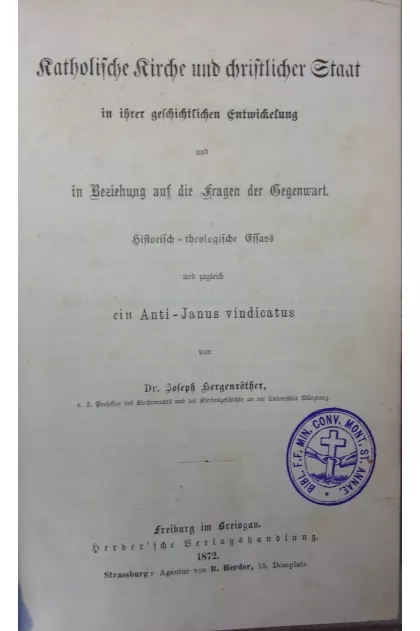
Katholirche Kirche und christlicher Staat, 1872 r. - Hergenröther, Joseph
Born in Würzburg, he was the second son of Johann Jacob Hergenröther, professor of medicine in the University of Würzburg. In 1842 Hergenröther completed with notable success his gymnasium course in his native town, and entered the University of Würzburg to take up a two-year course of philosophical studies, to which he added certain branches of theology. His historical tendencies exhibited themselves at this early age in a dramatic poem entitled Papst Gregor VII (Würzburg, 1841).
Bishop von Stahl took an interest in him, and in 1844 sent him to the Collegium Germanicum at Rome, whither he had already sent Heinrich Joseph Dominicus Denzinger and Franz Hettinger. Among his scholarly teachers were Giovanni Perrone and Carlo Passaglia in doctrinal theology, Tomei in moral theology, Antonio Ballerini in church history, Francis Xavier Patrizi in Scriptural exegesis, and Marzio in canon law.
The political troubles of 1848 prevented the completion of his theological studies at Rome; he was ordained to the priesthood 28 March of that year, and returned to Würzburg, where he pursued his ecclesiastical preparation for another year. In 1849 he was appointed chaplain at Zellingen, and for some time devoted himself to the duties of his office. In 1849 he stood successfully for the degree of doctor of theology before the University of Munich, and offered as his dissertation a treatise on the Trinitarian teaching of St. Gregory Nazianzen (Die Lehre von der göttlichen Dreieinigkeit nach d. heil. Gregor von Nazianz, Ratisbon, 1850). The qualities of the young doctor induced the theological faculty of Munich to offer him a place as instructor (privatdozent) in theology, which he accepted. Following ancient usage, he justified the confidence of the university by a printed thesis (Habilitationschrift) on the later Protestant theories of the origins of the Catholic Church (De catholicæ ecclesiæ primordiis recentiorum Protestantium systemata expenduntur, Ratisbon, 1851). Henceforth he devoted himself without reserve to his professorial duties.
In 1852 he was called to Würzburg, as professor extraordinary of canon law and church history; after three years (1855) he was promoted to the full possession of that chair. To his other duties he added the teaching of patrology. In those years Würzburg rejoiced in the possession of such theologians as Hettinger, Denzinger, Hähnlein, and Hergenröther.
Hergenröther was often honoured by election to the office of dean of his faculty, and occasionally to the University Senate; the latter office he never held after 1871, because of his opposition to Ignaz von Döllinger. For a similar reason he was never chosen to be rector of the university. Until 1869 Hergenröther was occupied as teacher and writer, chiefly with early Christian and Byzantine ecclesiastical history. The discovery (1851) of the Greek Christian text known as the Philosophoúmena led him to examine its disputed authorship in a series of studies in the Tübinger Theol. Quartalschrift (1852) and in the supplementary volume (1856) to the first edition of the Kirchenlexikon of Heinrich Joseph Wetzer and Benedict Welte. He again defended the authorship of Hippolytus in the Œsterreichische Vierteljahrschrift f. kath. Theol. (1863).
Hergenröther was especially interested in the career of Photius and in the origins of the Greek Schism, and kept up continuous research in the principal libraries for manuscripts of the works of Photius, in order to exhibit the original materials in as perfect a text as could be established. This led to the publication (Ratisbon, 1857) of the work, Photii Constantinopolitani Liber de Spiritus Sancti mystagogia. He contributed essays on the same work and on the Amphilochia of Photius to the Tüb. Theol. Quartalschrift (1858).
In 1860 appeared at Paris the Migne edition of "Photius".[2] It offered many textual emendations that were owing to Hergenröther, particularly in the "Amphilochia"; it was against his will that his earlier edition of the "Liber de Sp. Sancti mystagogia" was reprinted by Migne. When Aloys Pichler's work on the history of the separation of the Eastern and Western Churches appeared (Munich, 1864), Hergenröther was prepared to criticize it in the most thorough manner, which he did in a series of studies in a Würzburg theological periodical, the "Chilianeum" (1864–65), and in the "Archiv. f. kath. Kirchenrecht" (1864–65). The results of his twelve years of research in the history of the Greek Schism appeared finally in the classical work, Photius Patriarch von Constantinopel, sein Leben, seine Schriften, und das griechische Schisma (3 vols., Ratisbon, 1867–69). An additional volume bears the title: Monumenta Græca ad Photium ejusque historiam pertinentia (Ratisbon). In this monumental work it is difficult to say whether the palm belongs to the author's extensive knowledge of all the manuscript material, to his profound erudition, or to his calm objective attitude. Karl Krumbacher, the historian of Byzantine literature, says that the work cannot be surpassed. In these volumes Hergenröther laid here in minute detail the origins of the Byzantine Church, its development since the fourth century, and after the death of Photius until the completion of the schism in the twelfth and thirteenth centuries.
While professor of canon law at Würzburg, Hergenröther published several important historico-canonical essays on such subjects as early ecclesiastical reordinations (Ester, Vierteljahrsch. f. kath. Theol., 1862), the canonical relations of the various rites in the Catholic Church (Archiv f. kath. Kirchenrecht, 1862), the politico-ecclesiastical relations of Spain and the Holy See (ibid., 1863–66), and the canon law of the Greeks to the end of the ninth century (ibid., 1870). His interest in the ecclesiastical vicissitudes of his own day was manifested by valuable essays on the States of the Church after the French Revolution (Hist.-polit. Blätter, 1859), spirit of the age (Zeitgeist) and papal sovereignty (Der Katholik, 1861), and the Franco-Sardinian Treaty (Frankfort, 1865). Among his historico-apologetic essays are his treatises on the errors condemned by the Holy See in the Encyclical (Syllabus) of 8 December 1864 (in the Chilianeum, 1865), the veneration of the Blessed Virgin in the first ten centuries of the Christian Era (Münster, 1870).
He was a regular contributor of similar but briefer articles to the Würzburg periodicals, "Die katholische Wochenschrift" and the "Chilianeum". Hergenröther was constantly engaged in attempting to develop a genuine Catholic sentiment and truly Christian life among the faithful. He preached frequently, and was always a welcome speaker at the general assemblies of the German Catholic associations (Vereine; 1863–77). For the Fulda meeting of the Prussian bishops (1870) he prepared an exhaustive historical study on the spoliation of the Papal States, in which he developed at length the arguments for the temporal power of the papacy.