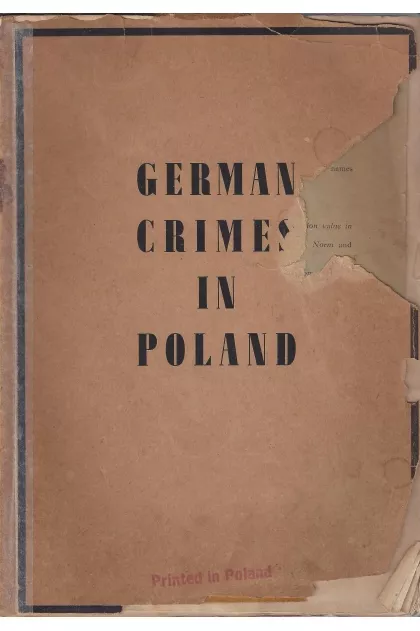
German crimes in Poland vol.I, 1946 - Praca Zbiorowa
German crimes against the Polish nation committed during the course of the 1939 invasion, as well as the subsequent occupation of Poland in World War II claimed the lives of 2.77 million ethnic Poles and 2.7 to 2.9 million Polish Jews, according to estimates of the Polish government-affiliated Institute of National Remembrance (IPN). Historians outside Poland put the number of Jewish victims of the Holocaust in occupied Poland at 3.0 million. The genocidal policy of the Nazi German government's colonization plan known as Generalplan Ost was the epicenter of the Nazi German war crimes against the Polish nation, and crimes against humanity committed from 1939 to 1945. The original assumptions of the Nazi plans, which were completely detached from reality, entailed the expulsion and mass extermination of around 85% (over 20 million) of the ethnically Polish citizens of Poland, with the remaining 15% to be used as slaves.In 2000, by an Act of the Polish Parliament, the dissemination of knowledge on the subject of Nazi German crimes in World War II was entrusted to an institute which replaced the former Main Commission for the Investigation of German Crimes against the Polish Nation.From the start of the war against Poland, Germany intended to realize the plan of territorial expansion, put forth by the Nazi leader Adolf Hitler in his book Mein Kampf, demanding the acquisition of the so-called living space (Lebensraum) in the East for massive settlement of German colonists. The object of war was to fulfill this territorial policy with the use of Nazi ideology of race. On 22 August 1939, just before the invasion of Poland, Hitler gave explicit permission to his commanders to kill "without pity or mercy, all men, women, and children of Polish descent or language."Ethnic cleansing was to be conducted systematically against Polish people: on 7 September 1939 Reinhard Heydrich stated that all Polish nobles, clergy and Jews are to be killed. On 12 September, Wilhelm Keitel added the intelligentsia to the list. On 15 March 1940, Himmler stated: "All Polish specialists will be exploited in our military-industrial complex. Later, all Poles will disappear from this world. It is imperative that the great German nation considers the elimination of all Polish people as its chief task." At the end of 1940, Hitler confirmed his pronouncement demanding liquidation of "all leading elements in Poland".The first mass deportation of Polish nationals by Nazi Germany occurred less than a year before the outbreak of war. It was the eviction from Germany of Jews holding Polish citizenship, during the Kristallnacht attack of 9–10 November 1938 carried out by the SA paramilitary forces. Approximately 30,000 Polish Jews were rounded up and sent via rail to prewar concentration camps throughout Germany, never to return. The round-up included 2,000 ethnic Poles living and working there.Also, before the attack on Poland, the Nazis prepared a detailed list identifying more than 61,000 Polish targets (mostly civilian) by name, with the help of the German minority living in the Second Polish Republic.The list was printed secretly as the 192-page-book called Sonderfahndungsbuch Polen (Special Prosecution Book–Poland), and composed only of names and birthdates. It included politicians, scholars, actors, intelligentsia, doctors, lawyers, nobility, priests, officers and numerous others – as the means at the disposal of the SS paramilitary death squads aided by Selbstschutz executioners. The first Einsatzgruppen of World War II were formed by the SS in the course of the invasion. They were deployed behind the front lines to execute groups of people considered, by virtue of their social status, to be capable of abetting resistance efforts against the Germans.The most widely used lie justifying indiscriminate killings by the mobile action squads was (always the same) made-up claim of purported attack on German forces.In total, about 150,000 to 200,000 Poles lost their lives during the one-month September Campaign of 1939, characterized by the indiscriminate and often deliberate targeting of civilian population by the invading forces.Over 100,000 Poles died in the Luftwaffe's terror bombing operations, like those at Wielun. Massive air raids were conducted on towns which had no military infrastructure.The town of Frampol, near Lublin, was heavily bombed on 13 September as a test subject for Luftwaffe bombing technique; chosen because of its grid street plan and an easily recognisable central town-hall. Frampol was hit by 70 tonnes of munitions,which destroyed up to 90% of buildings and killed half of its inhabitants.Columns of fleeing refugees were systematically attacked by the German fighter and dive-bomber aircraft.Amongst the Polish cities and towns bombed at the beginning of war were: Brodnica,Bydgoszcz, Chelm, Ciechanów, Czestochowa,Grodno, Grudziadz, Gdynia,Janów, Jaslo,Katowice,Kielce,Kowel, Kraków, Kutno,Lublin,Lwów, Olkusz,Piotrków,Plock, Plonsk, Poznan, Puck, Radom, Radomsko, Sulejów,Warsaw, Wielun, Wilno, and Zamosc.Over 156 towns and villages were attacked by the Luftwaffe. Warsaw suffered particularly severely with a combination of aerial bombardment and artillery fire reducing large parts of the historic centre to rubble, with more than 60,000 casualties. The Soviet Union assisted the Germans by allowing them to use a radio beacon from Minsk to guide their planes.