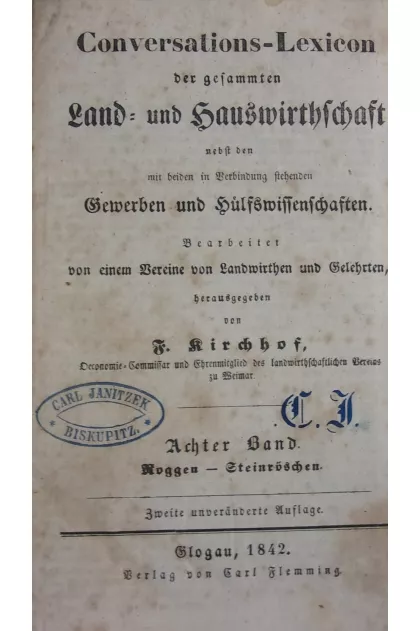
Conversation-Lexicon, 1842r. - Kirchhof
Collection of prayers for Tikkun Hazot (midnight prayers) and for other kabbalistic rituals of the Lurianic school. R. Nathan Nata Hannover (d. 1683) was a preacher, kabbalist, lexicographer, and chronicler. During the Chmielnicki massacres of 1648, he had to leave his birthplace in Volhynia to wander through Poland, Germany, and Holland for several years. His sermons, delivered during those years of wandering, were compiled into a book covering the entire Pentateuch. In 1653 he went to Italy. In the same year in Venice, he published Yeven Mezulah ("Miry Pit"), dealing with the Chmielnicki persecutions. He associated with the great kabbalists of the period: R. Samuel Aboab and R. Moses Zacuto, R. Hayyim Cohen, R. Nathan Shapira, and R. Benjamin ha-Levi of Safed. He studied the Kabbalah doctrines of the school of R. Isaac Luria for a number of years.
In 1660 in Prague, Hannover published Safah Berurah ("Clear Language"), a Hebrew-German-Latin-Italian conversation lexicon, text, and guidebook for travelers, and in 1662, Sha'arei Ziyyon ("Gates of Zion"). These two books were the result of his studies in Italy. In 1662, he was appointed president of the bet din and head of the yeshivah in Jassy, Walachia, which was then a Turkish province. He was still in Jassy in 1666, the "year of redemption," when the Messiah was due according to the beliefs of the Shabbatean movement. He spent about ten years in Jassy and, according to tradition, in Pascani too. He then moved to Ungarisch Brod, Moravia, on the Hungarian border, where he was preacher and religious judge. He was killed, while praying with the community, by Turkish soldiers who raided the town.
Sha'arei Ziyyon, was reprinted over 50 times. It served as a channel for introducing into the ordinary prayer book certain elements of the Lurianic Kabbalah, such as the Berikh Shemei prayer. Safah Berurah also had several editions, being published both under its own title and other titles in its original form and in a modified version. Up to the 19th century, it was used for the study of foreign languages in Central and Eastern Europe. It is still an important source for research into the Yiddish and the Hebrew used in the author's time. Yeven Mezulah, on the Chmielnicki pogroms of 1648–52, has relatively few personal experiences of the author. It is mainly based on eyewitness accounts of others and hearsay evidence (including information Hannover found in print). R. Hannover's broader vision, lucid language, and simple and graceful manner of relating events gave the book an appeal it still retains. Among the Ashkenazi Jews, it was reprinted in the original version and in Yiddish translation, in almost every generation. It was translated into French (1855), German (1863), Russian (1878), Polish (1912), and English (Abyss of Despair, 1950).
In 1791 R. Moses Shapira, son of the zaddik R. Phinehas b. Abraham of Korets, founded the printing press Slavuta became known for. Later R. Moses' two sons, Samuel Abba and Phinehas, took over the administration of the press. Three editions of the Babylonian Talmud, an edition of the Bible (with commentaries), the Zohar, and many other religious works, especially hasidic literature, were all produced handsomely and with great care by the press. In 1835 the press was closed down when the owners were arrested for the alleged murder of a worker who had supposedly denounced them for printing books without permission from the censor. After the closing of the famed Slavuts Press the surviving brother, R. Haninah Lipa Shapira, supervised production of religous works at the Jozefow press. His name appears on the title with the Slavuta inscription. The Shapira press was restarted in Zhitomir in 1847.