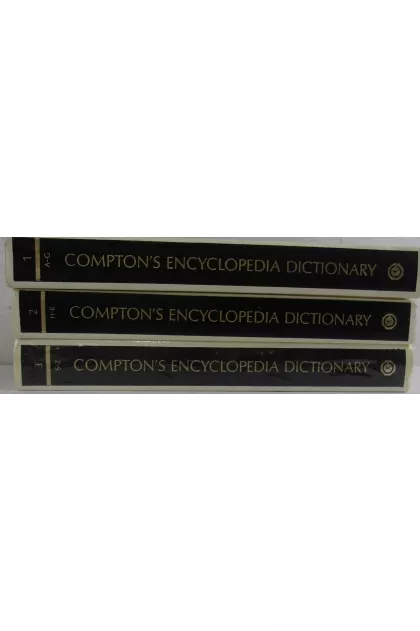
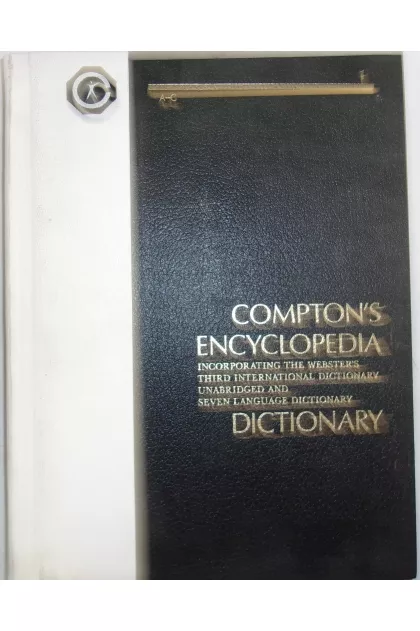
Compton's encyklopedia dictionary t:1-3, reprint, 1966r - Praca Zbiorowa
Webster's Third New International Dictionary of the English Language, Unabridged (commonly known as Webster's Third, or W3) was published in September 1961. It was edited by Philip Babcock Gove and a team of lexicographers who spent 757 editor-years and $3.5 million. It contained more than 450,000 entries, including more than 100,000 new entries and as many new senses for entries carried over from previous editions.
The final definition, Zyzzogeton, was written on October 17, 1960; the final etymology was recorded on October 26; and the final pronunciation was transcribed on November 9. The final copy went to the typesetters, RR Donnelley, on December 2. The book was printed by the Riverside Press in Cambridge, Massachusetts. The first edition had 2,726 pages (measuring 9 in (23 cm) wide by 13 in (33 cm) tall by 3 in (7.6 cm) thick), weighed 13½ lbs (6.12 kg), and originally sold for $47.50 ($389 in 2017 dollars[1]). The changes were the most radical in the history of the Unabridged.
Although it was an unprecedented masterwork of scholarship, it was met with considerable criticism for its descriptive (rather than prescriptive) approach. It told how the language was used, not how it ought to be used.[2]Prior to Webster's Third the Unabridged had been expanded with each new edition, with minimal deletion. To make room for 100,000 new words, Gove now made sweeping deletions, dropping 250,000 entries. He eliminated the "nonlexical matter" that more properly belongs to an encyclopedia, including all names of people and places (which had filled two appendices). There were no more mythological, biblical, and fictional names, nor the names of buildings, historical events, or art works. Thirty picture plates were dropped. The rationale was that, while useful, these are not strictly about language. Gove justified the change by the company's publication of Webster's Biographical Dictionary in 1943 and Webster's Geographical Dictionary in 1949, and the fact that the topics removed could be found in encyclopedias.[3]
Also removed were words which had been virtually out of use for more than two hundred years (except those found in major literature such as Shakespeare), rare variants, reformed spellings, self-explanatory combination words, and other items considered of little value to the general reader. The number of small text illustrations was reduced, page size increased, and print size reduced by one-twelfth, from six point to agate (5.5 point) type. All this was considered necessary because of the large amount of new material, and Webster's Second had almost reached the limits of mechanical bookbinding. The fact that the new book had about 700 fewer pages was justified by the need to allow room for future additions.
In style and method, the dictionary bore little resemblance to earlier editions. Headwords (except for "God", acronyms pronounced as a string of letters, and, in the reprints, trademarks) were not capitalized. Instead of capitalizing "American", for example, the dictionary had labels next to the entries reading cap (for the noun) and usu cap (for the adjective). This allowed informative distinctions to be drawn: "gallic" is usu cap while "gallicism" is often cap and "gallicize" is sometimes cap.
The reviews of the Third edition were highly favorable in Britain.[4]
Robert Chapman, a lexicographer, canvassed fellow lexicographers at Funk & Wagnalls, who had used the new edition daily for three years. The consensus held that the Third was a "marvelous achievement, a monument of scholarship and accuracy". They did come up with some specific criticisms, including typographic unattractiveness (the type is too small and hard to read); non-use of capital letters (only "God" was capitalized; the goal was to save space); excessive use of citations, giving misspellings as legitimate variants, dropping too many obsolete words, the lack of usage labels, and deliberate omission of biographical and geographical entries. Chapman concluded that the "cranks and intransigents who advise us to hang on to the NID 2 are plain fools who deny themselves the riches of a great book".[5]
This dictionary became preferred as a backup source by two influential style guides in the United States, although each one directs writers to go first to other, shorter dictionaries. The Chicago Manual of Style, followed by many book publishers and magazines in the United States, recommends Webster's Third, along with Merriam-Webster's Collegiate Dictionary for "general matters of spelling", and the style book "normally opts for" the first spelling listed (with the Collegiate taking precedence over Webster's Third because it "represents the latest research").[6] The Associated Press Stylebook, used by most newspapers in the United States, refers readers to W3 "if there is no listing in either this book or Webster's New World".[7]
Webster's third New international dictionary of the English language unabridged with seven language dictionary volume I - A to G 1966r. 1016str.
Webster's third New international dictionary of the English language unabridged with seven language dictionary volume II- H to R 1966r. 1017-1991str.
Webster's third New international dictionary of the English language unabridged with seven language dictionary volume III- S to Z 1966r (nowa książka)