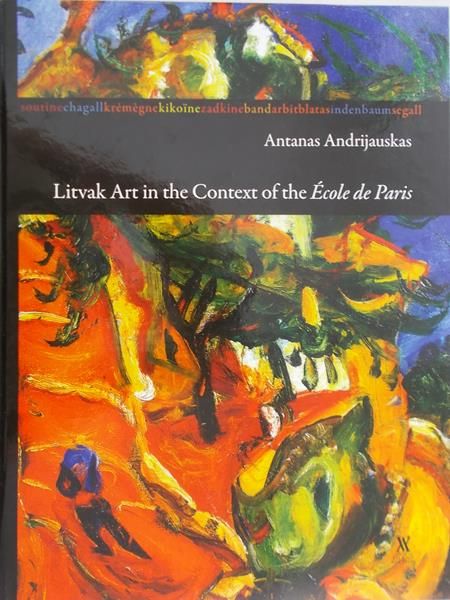
Andrijauskas Antanas - Litvak Art in the Context of the Ecole de Paris
Some studies, like this one, begin as fragmentary thoughts recorded on various occasions: they are born naturally and imperceptibly when the time is right. In my childhood, while wandering with a fishing pole outside Veisiejai near Lake Ančia, I slipped, and my feet disturbed a thick layer of moss under which was buried a dark stone with strange characters in an unknown language. My elders later told me that these were vestiges of the Lithuanian Jewish culture that had once existed here. That was my first contact with the culture of Lithuanian Jews, the Litvaks. I learned that before World War II, in Veisiejai, a small town in Dzūkija, there had been a large Jewish community. The inventor of Esperanto, L. L. Zamenhof, had also lived here. When I moved there with my parents after the war, at the age of six, there were no Litvaks left in this town. The entire community was mercilessly annihilated.
Much later, in my travels, I continued to encounter, in various contexts, manifestations of Litvak culture – works in Parisian exhibition halls and galleries with the names of Jewish Litvak artists who represented the third generation residing abroad. Next to their names I often saw the words litvak or juif d’origine lituanienne. It greatly intrigued me that in Paris so many people identified themselves with – and had roots in – my native Lithuania. When teaching in Japan, I noticed that my Japanese colleagues saw no difference between Lithuanian and Jewish names, whether written in Japanese characters or in Latin letters. For them, the Lithuanian contribution to world culture is often associated not only with ethnic Lithuanians like Mikalojus Konstantinas Čiurlionis, Jurgis Mačiūnas, Jonas Mekas, Jurgis Baltrušaitis (son), Algirdas Julius Greimas, or Marija Gimbutas but also with famous Jews born in Lithuania like Chaïm Soutine, Jacques Lipchitz, Jascha Heifetz, Bernard Berenson, Meyer Schapiro, Emmanuel Lévinas, Arbit Blatas and others.
When I was an intern at the Sorbonne and the Collège de France, the original paintings and sculptures that I saw at various museums in Paris stimulated my interest in the works of these Litvaks who had been students at art schools in Vilnius, Kaunas, and Vitebsk. Subsequently, for a quarter of a century, I studied the works of many masters of the École de Paris. I reflected not only on the aesthetic value of their works but also on the reasons that impelled such a large group of Litvaks to become a part of the artistic life of Paris, the leading center of Western civilization in the early 20th century.
This fact forced me to reflect upon the history of Lithuanian culture and art in general and the narrowly nationalistic vision of historiography drilled into my head during childhood and at the Kaunas School of Art, where I studied. When I began to transcend ethnocentric attitudes and cast a wider glance at the richness and diversity of the multi-ethnic, poly-confessional culture of the Grand Duchy of Lithuania, it became clear to me that Lithuania and her capital Vilnius occupy a singular place in the history of European civilization. In this broader vision of Lithuania, ethnically Lithuanian culture does not stand isolated. It includes the unique heritage of the many other peoples who enriched the polyphonous diversity of the historic Grand Duchy of Lithuania – Jews, Poles, Belarussians, Russians, Tartars, Karaites, and others, without whose contributions we cannot adequately understand the changing historical processes in the centers of this vast cultural space.
Recently, we have begun to take a different, broader, more sensitive look at the complex cultural history of our country. We have sensed that it is vitally important to integrate the heritage of these peoples into Lithuanian cultural history. In this respect, the history of Litvak culture is of special interest. This ethnic group formed during the sixteenth to eighteenth centuries, in the territory of present-day Lithuania, Latvia, Belarus, and Ukraine. Its members followed the precepts and cultural traditions of Judaism more strictly than other Jewish groups, and they devoted great attention to education and learning. For centuries, the dominant atmosphere in multicultural Lithuania was far more tolerant than in other Western European countries: the coexistence of different peoples and religions was legally established by the Lithuanian statutes, which were unique in Europe, and through various privileges granted by the rulers. At that time in history, the tolerance found in Lithuania for the religions of other peoples did not exist in any other European state. Thus, Jewish arrivals quickly put down roots and regarded Lithuania as their second fatherland, where for centuries their rapidly growing communities were able to cultivate their cultural and religious traditions. In the Jewish world, the cultural space of the original Grand Duchy of Lithuania was traditionally called Lite (in Yiddish) or Lita (in Hebrew), i.e. Lithuania, and the Jews who lived here were Lithuanian Jews, or Litvaks – people who spoke a Lithuanian dialect of Yiddish. In the huge multicultural and poly-confessional territory, they zealously sought to preserve the centuries-old traditions of Judaism and of their own Litvak culture. Among Eastern and Central European Jews, the Litvaks had perhaps the greatest national consciousness and were tenacious in observing their cultural traditions and religious precepts. This is probably the answer to why even third-generation descendants of these Jews, when reflecting on their cultural identity, invoke the concepts Lita, litvak, juif d’origine lituanienne.
In the early 20th century, Litvak artists invaded the main center of Western modern art as the so-called second wave of the École de Paris. Their long-suppressed creative energy exploded in the fine arts and extended to the main cultural centers of Western Europe, Paris, Berlin, Vienna, and Munich, where these emigrants became an active part of the artistic avant-garde. They also laid the foundation for professional national Jewish painting and sculpture in the twentieth century. Thus, the story of Litvak art and its contribution to Lithuanian and world culture is one of many narratives flowing from the depths of our history.
In Lithuania, in recent years, more and more research is appearing by authors who seek to look at our cultural history more expansively, without ethnocentric stereotypes, and to acknowledge that other peoples have also made important contributions to the history of our art. This belated interest has painful repercussions for scholars eager to work in this field because so much valuable archival material has disappeared during times of upheaval, war, occupation, and changes in national borders. Persons who could provide authentic information have already departed from this world.
When I began to delve into the question of the role of Litvaks in French modern art, I was amazed to learn that most of the famous Jewish artists came from the famous Vilnius School of Drawing, from Yehuda Pen’s School of Painting and Drawing in Vitebsk, and from the Kaunas School of Art. Yet this topic has remained largely unexplored by Lithuania scholars. To date we have only one doctoral dissertation in 2005 by Vilma Gradinskaitė1 dealing with this subject.
Litvaks in the Pale of Settlement
After the dissolution of the Republic of the Two Nations through the three partitions of Poland and Lithuania in 1772, 1793, and 1795, the former Grand Duchy of Lithuania became part of the Russian Empire, and the Russian tsars issued many discriminatory edicts that changed the status of one of the world’s largest Jewish communities. Most devastating were the edicts of 1772 and 1779, which forbade Jews in the former GDL and Poland to leave their native lands, thus establishing strictly demarcated boundaries for what became known as the Pale of Settlement. In 1791, there were about 1.5 million Jews living in the Pale of Settlement, of whom around 95-97 percent spoke Yiddish and considered themselves a separate ethnocultural group – Litvaks; on the eve of the Russian Revolution there were about seven million.
! Uwagi:
Oprawa lekko wytarta i pozaginana. Brzegi stron minimalnie zakurzone.